
Invoices, contracts, delivery notes, forms: most business information arrives as documents. People can read them. Software cannot, at least not without help.
That gap is the difference between unstructured and structured data.
Structured and unstructured data
Structured data has a fixed format. Every value has a name and a place: customer number, amount, date. Databases, ERP systems and spreadsheets work with structured data.
Unstructured data has no such format. A scanned letter, a PDF contract or a photo of a form contains the same information, but as running text or as an image. A program cannot tell where the amount is.
Forms sit in between. They have fields, but the entries are often handwritten or ticked.
Why unstructured documents slow processes down
As long as information is stuck in documents, someone has to copy it by hand. That takes time and introduces typing errors. And the data cannot be searched, evaluated or passed on until it has been typed in.
How documents become structured data
Document processing turns documents into structured data in three steps:
- Text recognition reads printed and handwritten text, tables, barcodes and checkboxes.
- Classification recognises the document type.
- Extraction pulls out the values and gives each one a name, for example “invoice_number” or “due_date”.
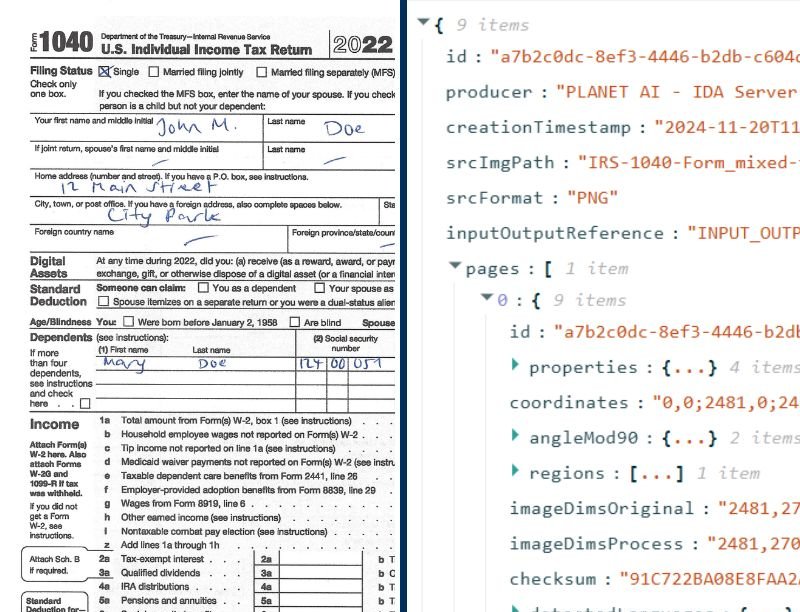
Left: a tax form as a scan or PDF. Right: the data IDA has read from it, as structured JSON. Every value can now be processed by software.
More on the individual steps in our blog posts on digital document capture and PDF classification.
Output formats: PDF and JSON
IDA delivers its results in two formats, depending on where they are needed.
A searchable PDF keeps the original document and adds a text layer. People can read it, search it and file it in the DMS.
JSON contains the extracted data in a structured form. Other systems can read it directly, without anyone typing anything.
Frequently asked questions
What are structured data?
Data in a fixed format, where every value has a name and a place, for example in a database or a spreadsheet.
What are unstructured data?
Information without a fixed format, such as running text in letters, contracts, emails or scans. People can read it, software cannot without help.
Why JSON?
JSON is a widely used text format for structured data. Almost every system can read it, which makes it the usual way to hand over extracted data.
Can handwritten entries become structured data?
Yes. Handwriting recognition reads handwritten entries in forms just like printed text. IDA recognises handwriting with an accuracy of more than 95 % and machine print with more than 99 %.
See it with your documents
In a demo, we show you how IDA turns documents like yours into structured data.